

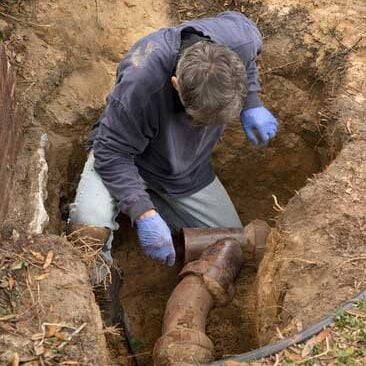
Most homeowners never think about their sewer line until something goes wrong. It sits buried under the yard, doing its job quietly for decades, right up until slow drains, strange smells, or a backup make it impossible to ignore. By the time those problems show up, the damage underground has often been building for a while.
We hear from homeowners across Seattle and the surrounding areas who notice something feels off with their plumbing but aren’t sure if it’s a simple clog or a bigger sewer line problem. Older neighborhoods with aging clay, cast iron, or Orangeburg pipe are especially prone to slow, gradual sewer line damage that’s easy to miss until it becomes serious.
Noticing warning signs of sewer line trouble at your home? Reach out to Gene Johnson Plumbing, Heating, Cooling & Electrical for trusted sewer line repair and replacement in Seattle. Call us today at 206.792.7495 or contact us online for a free quote.
Multiple Slow or Backed-Up Drains at the Same Time
A single slow drain is usually a local, isolated clog, something stuck in one branch line that a plunger or a drain snake can clear. It’s a different story when several fixtures start acting up around the same time. If your kitchen sink, your shower, and your toilet are all draining slowly, or backing up together, the problem is more likely in the main sewer line rather than any one fixture.
This pattern happens because everything in your home’s plumbing eventually feeds into that single main line. When it’s partially blocked or damaged, everything upstream of the blockage starts to back up, even if each fixture seems to have its own separate issue at first glance.
Gurgling Sounds From Toilets or Drains
A gurgling sound after you flush the toilet or run the dishwasher is air being forced back through the pipes because it can’t escape the way it normally would. That trapped air is often a sign that something downstream, whether it’s a partial blockage, a bellied section of pipe, or root intrusion, is disrupting normal flow.
This is one of the earliest and most reliable signs of a developing sewer line problem, and it’s worth paying attention to even if nothing has backed up yet.
A Persistent Sewage Smell In or Around Your Home
Sewer gas has a distinct, unpleasant smell, and you shouldn’t be able to smell it inside your home or out in your yard under normal conditions. When you do, it usually means a pipe has cracked, a joint has separated, or wastewater is escaping somewhere along the line instead of flowing to the city main.
Indoors, this smell often shows up near floor drains, in basements, or around fixtures. Outdoors, it tends to be strongest directly above the sewer line’s path, and can get noticeably worse after rain, when moisture pushes trapped gases up through the soil.
Soggy Patches or Unusually Green Grass in Your Yard
A leaking sewer line changes the soil around it, and that shows up in ways you can actually see from your yard:
- Soggy or sunken spots: soil above a damaged pipe can wash away or stay saturated, creating soft or slightly sunken patches of lawn.
- Unusually green grass: wastewater acts like fertilizer, so one strip of lawn growing noticeably greener or faster than the rest is a classic tell.
- Standing water with no clear source: puddles that persist in dry weather, especially along the path between your house and the street, can point to a leak below.
Cracks in Your Foundation or a Sinking Sidewalk
A sewer line that’s leaking underground can slowly erode the soil supporting your foundation, driveway, or sidewalk. Over months or years, that erosion can show up as new foundation cracks, or as a section of sidewalk or pavement that starts to sink or shift out of alignment. These are slower-developing signs, but they’re also some of the more expensive ones to ignore.
An Increase in Pest Activity
Rodents and insects are drawn to the moisture and organic material that comes with a damaged sewer line. If you’ve noticed more pest activity than usual, particularly near your yard, crawl space, or the area where your sewer line runs, it’s worth considering as part of the bigger picture rather than a separate, unrelated problem.
When It’s a Repair and When It Might Be More Serious
Most of the signs above point to a developing issue that a professional can typically resolve with a targeted repair, especially when it’s caught early. A camera inspection is the most reliable way to see exactly what’s happening inside the pipe and confirm whether a repair will solve the problem or whether a section needs to be replaced.
If you’re dealing with sudden, severe backups rather than a slow pattern of symptoms, it’s worth reading our post on how to tell if your sewer line has fully collapsed, since that’s a more urgent version of the same underlying problem.
Get Professional Sewer Line Repair in Seattle, WA From Gene Johnson!
Sewer line problems rarely improve on their own, and catching the warning signs early almost always means a simpler, less expensive fix. If any of this sounds familiar, from slow drains to a sewage smell you can’t explain, it’s worth having a professional take a look before it turns into a bigger repair.
At Gene Johnson Plumbing, Heating, Cooling & Electrical, we’ve helped Seattle homeowners diagnose and repair sewer line issues for decades, using camera inspections to confirm the real problem before recommending a fix. Call us today at 206.792.7495 or contact us online to schedule an inspection.